Many different types of adhesives, such as EVA, PSA, polyurethane, polyamide, and polyolefin, can be applied to products using hot melt adhesive systems. The selection of these different types and, consequently, the choice of hot melt adhesive equipment, is crucial for both bonding quality and a feasible economical investment. When all these factors are combined, hot melt adhesive systems provide a wide range of products and endless configurations.
This page summarizes what hot melt adhesive (hotmelt) is and what to consider when selecting equipment.
Hot melt adhesives are thermoplastic chemicals that are 100% solid and contain no solvents or water.
Hot melt adhesive consists of three basic components:
- Polymer: A material that provides basic mechanical properties, strength, and flexibility.
- Resin: A material that provides adhesion.
- Plasticizers: A material that provides viscosity control and ease of application.
How Hot Melt Adhesive Works
Hot melt adhesive is used to bond two materials, either the same or different, or in some cases, simply for sealing. The adhesive, which is heated to a liquid form, is first applied to one material, and shortly afterward, it is bonded to the second material. The rapidly cooling adhesive holds the two materials together.
Factors Affecting Application
- Application Temperature
- Amount of Adhesive Applied
- Pressure
- Adhesive Open Time
- Structure of the Product to be Applied
Advantages of Hot Melt Adhesive
- Long shelf life
- Short curing time
- No thickness loss when solidified
- Very little or no VOCs (volatile organic compounds)
- Cost
Packaging Types
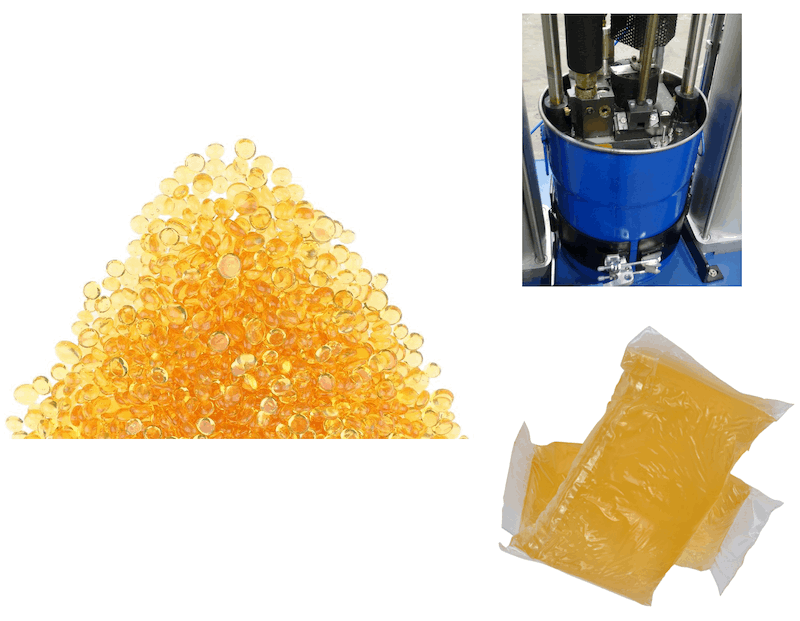
Hot melt adhesive is available in bead, cushion, mold, and drum (20lt and 200lt) formats, depending on the type.
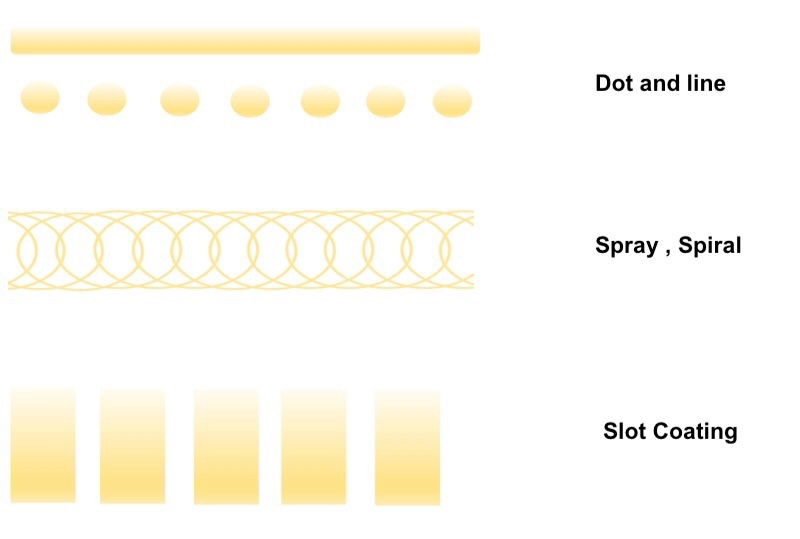
Dot and Line
This type of system is used for basic applications such as box/carton sealing, product crushing, and gasketing. It repeats for as long as the voltage of the solenoid valve on the gun is extended. In systems where a signal is given in milliseconds, the gun sprays a dot.
Spiral, Spray
Following the pressurized air applied at the nozzle outlet, the adhesive is applied to the product in a spiderweb-like form by rotating with air. With this application, large areas can be covered with a small amount of glue. It can be used especially in nonwovens, big bags, and automotive applications.
Slot Coating
The glue is applied in a spreading manner by contacting the product through an opening of the nozzle. Coating can be done on the product with slot nozzle on a the length manufactured according to specifications.
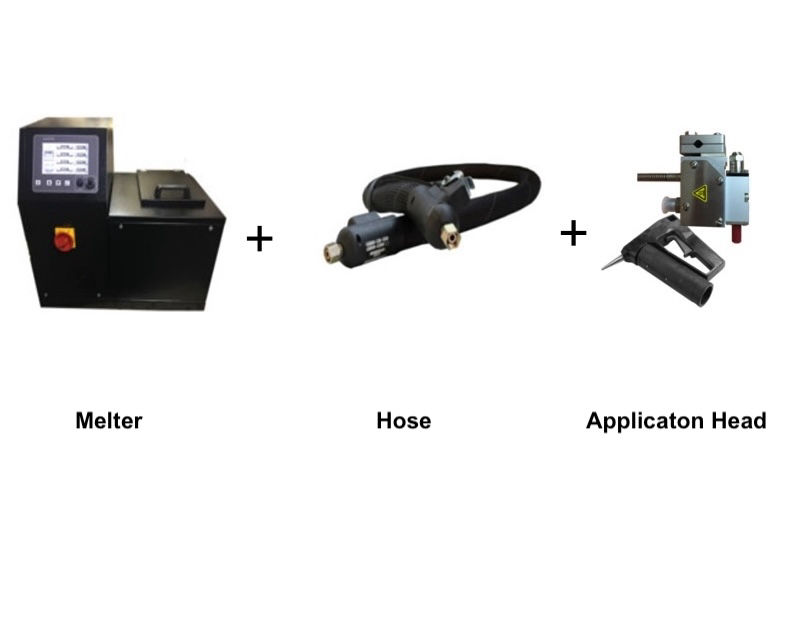
Hot melt adhesive systems consist of three main components: melter, hose, and application head.
Note: All these units are pre-configured products. Multiple hoses and nozzles can be attached to a single machine.
Melter
Depending on the type of adhesive, the amount to be applied, and the type of pump, these temperature-controlled machines, with tank capacities starting from 5 liters, melt the glue and transfer it under pressure.
Hoses
These are heated and temperature-sensor controlled hoses necessary for transferring the glue, which is melted and pressurized inside the melter, to the application guns. Their lengths can vary depending on the distance between the machine and the gun. One or more hoses can be provided from the machine.
Application Heads
These are automatic or manual adhesive applicators, designed in various ways, that apply adhesive delivered via a hose to the product in an on/off manner. The adhesive application is opened and closed using valves called modules or injectors. Nozzles are attached to these modules according to the application.